

Wine education gets confusing fast. CMS, WSET, MW… which path actually fits your goals? Here’s a breakdown of wine sommelier levels and what they really mean.
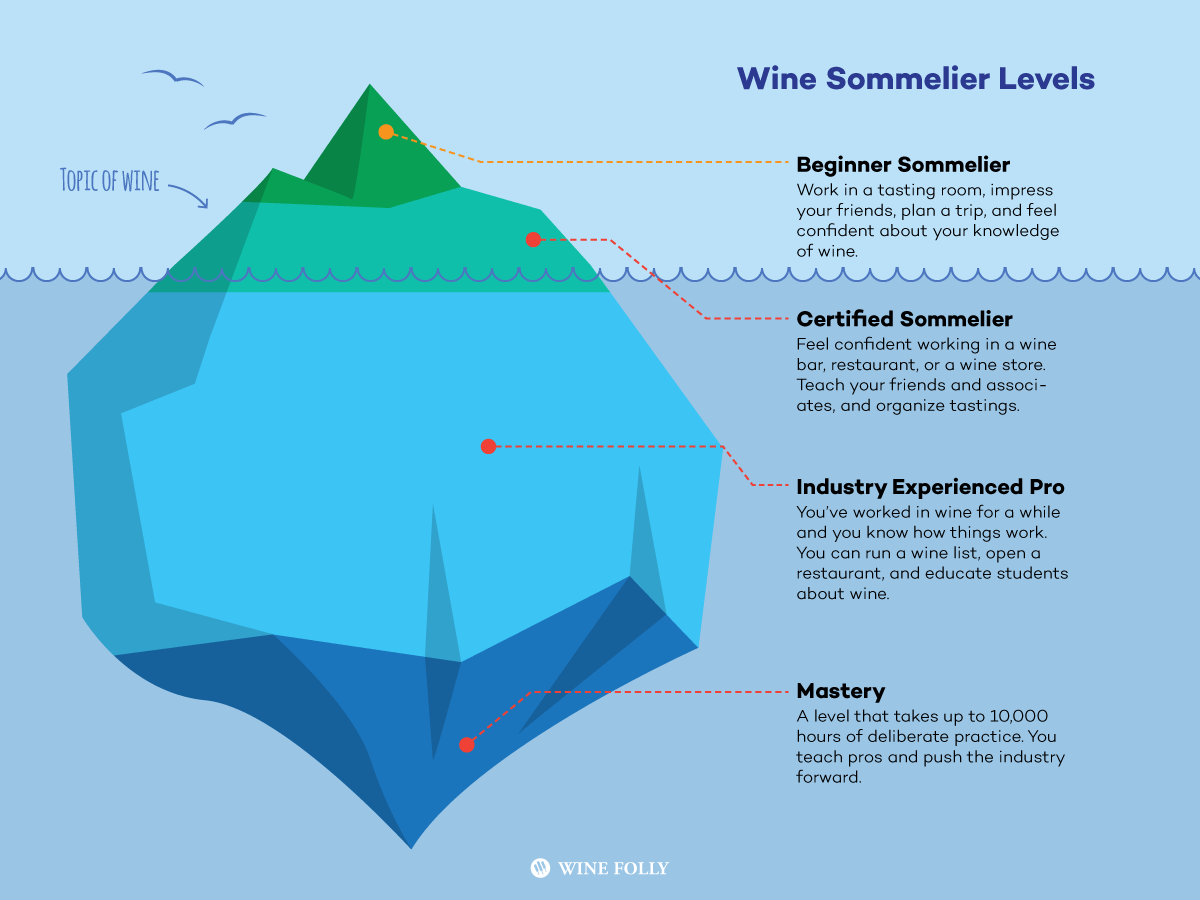
Wine Sommelier Levels
- Beginner Level: Build enough wine confidence to navigate restaurant lists, tasting rooms, travel, and everyday wine buying without guessing.
- Certified Level: Feel confident working in a wine bar, restaurant, or a wine store. Teach your friends and associates, and organize tastings.
- Industry Experienced Pro: You understand buying, service, tasting, inventory, and the realities of running a beverage program.
- Mastery: Years of disciplined tasting, study, service, and real-world experience. You teach pros and push the industry forward.
In this article, we’ll focus on two popular wine sommelier training programs: Wine & Spirit Education Trust (WSET) and Court of Master Sommeliers (CMS). At the bottom, you’ll also see details on the other major programs, including how Wine Folly courses fit into the mix.

CMS vs WSET: What’s the difference?
At first glance, CMS and WSET can look similar. In practice, they train very different skill sets. A few to note:
- The Court of Master Sommeliers (CMS) is service-oriented and focuses on restaurant and hospitality performance.
- WSET focuses more heavily on wine knowledge, tasting analysis, production, and commercial understanding.
- CMS expects students to drive much of their own study outside the classroom, followed by a 1- to 3-day course and exam.
- WSET offers a more structured classroom format with guided study and staged progression.
- CMS requires students to pass each course before moving to the next. Most WSET levels do not require prerequisites until the Diploma level.
How long does it take to earn a wine certification?
It depends on your goals, study time, and chosen path. Most structured wine education programs take at least one year to complete at an introductory or intermediate level, with advanced certifications requiring multiple years of study.
Why get a wine certification?
Wine certifications are one way (not the only way) to build expertise. They can help:
- strengthen tasting accuracy
- build structured wine knowledge
- improve job opportunities in hospitality, retail, education, and importing
- provide credibility in professional wine environments

Court of Master Sommeliers (CMS)
Level 1: Introductory Course
Getting Started
Time to Prepare: This level covers the foundations: major grapes, regions, service basics, spirits, sake, and beer. Students must score 60% or higher to pass.
Hospitality or beverage experience is recommended, though not required. Students also learn the CMS deductive tasting method for evaluating wine systematically, so if you’re looking to hone your skills, we’ve got a terrific article that should get you going.
Level 2: Certified Sommelier Examination
A Depth of Information
Time to Prepare: ~1 year recommended
Level 2 moves beyond memorization to practical application, exploring concepts more deeply and building on the knowledge from Level 1. You’ll need to prepare for this exam on your own.
The Certified Sommelier exam is a one-day examination that tests whether you can perform under real hospitality pressure. To pass this level, you must complete all three of the following exams with at least 60% correct answers on each section, simultaneously:
- Blind Tasting: 4 wines in 30 minutes
- Theory Exam: 45 questions
- Service: restaurant-style service evaluation
Level 3: Advanced Sommelier
Putting Your Knowledge & Skills to the Test
Time to Prepare: ~1+ years plus industry experience
Blind tasting groups and mentorship become almost essential at this stage. Study with people who consistently taste better than you do. This exam is a real commitment and requires a 60% pass rate on each of the following sections:
- Theory: A written exam concerning knowledge of wine, beverages, and sommelier practices.
- Tasting: A face-to-face verbal evaluation of tasting ability.
- Service: A practical demonstration of service abilities.
Level 4: Master Sommelier
Think Like A Master
Time to Prepare: 3+ years after Level 3
The Master Sommelier path demands intense discipline, emotional endurance, and years of sustained study. The exam itself, plus the time and personal commitment, make this no easy task. Here’s what it takes:
- Oral Theory Exam: A 50-minute verbal exam about the responsibilities of a sommelier.
- Tasting Exam (6 wines): Describe and identify six different types of wine successfully.
- Wine Service Exam: Prepare and present a proper wine service, including glassware, decanting, and answering customer questions.
This is where wine study turns into full-scale immersion. The pass rate of the theory portion of this exam is approximately 10%. Afterwards, grab yourself a glass of Champagne and pat yourself on the back. The full CMS test details are here.

Wine & Spirit Education Trust (WSET)
Level 1: WSET Level 1 Award in Wines
The Beginner’s First Step
Time to Prepare: ~6 hours
WSET Level 1 works well for curious beginners who want structured wine fundamentals without industry pressure. The one-day course concludes with a multiple-choice exam. Topics span the principal wine types, including common grape varieties, wine styles, and food-and-wine pairings.
Level 2: WSET Level 2 Award in Wines
Welcome to the Deep End
Time to Prepare: ~28 hours
Here’s where CMS and WSET start to really show their differences. Unlike CMS, WSET Level 2 focuses entirely on theory and tasting knowledge rather than hospitality service. Series classes are offered and span a few weeks. The main focus of this exam is on tasting and describing wine, grape varieties, regions, and winemaking. Students with strong foundational knowledge may skip directly to Level 2.
Level 3: WSET Level 3 Award in Wines
Now Wine Gets Technical
Time to Prepare: ~84+ hours
This advanced-level class covers in-depth wine regions, wine and food pairings, and principal wine types. Success at this level depends less on memorization and more on explaining cause and effect in wine.
The Exam includes:
- Tasting Portion: A blind tasting of two different wines.
- Theory: A written exam, including multiple choice and short answer questions.
Curious how to achieve this level? Find others who love studying wine as much as you do! Peer study and tasting groups are a great option.
Level 4: WSET Level 4 Diploma in Wines
This Is the Marathon
Time to Prepare: 18 months–3 years
The highest level within the WSET system, expect a major jump in reading, tasting, and written analysis. A six-unit program covering viticulture, winemaking, global wine regions, sparkling and fortified wines, business, and research-based study.
Check out the full details for each exam here.
Other Wine Sommelier Options
Institute of Masters of Wine (IMW)
A globally recognized advanced qualification focused on deep theoretical and analytical wine expertise. One of the most demanding wine programs in the world.
The International Sommelier Guild (ISG)
A structured introductory program covering foundational wine knowledge and tasting.
Society of Wine Educators
Offers certifications for wine and spirits education, widely used in sales, retail, and education sectors. The full range of certifications includes:
- Hospitality/Beverage Specialist (HBSC)
- Certified Specialist of Wine (CSW)
- Certified Wine Educator
- Certified Specialist of Spirits
- Certified Spirits Educator
Wine Scholar Guild
The WSG specializes in certifications dedicated to specific wine-producing countries and regions, including:
- French Wine Scholar – including specialty programs for Bordeaux, Bourgogne, Alsace, Champagne, Provence, Rhône, and Loire Valley.
- Italian Wine Scholar
- Spanish Wine Scholar
Wine study has a way of escalating quickly. One tasting becomes flashcards, maps, blind-tasting groups, and shelves of wine references.
The path you choose depends less on prestige and more on purpose:
- hospitality service
- retail or sales
- education or communication
- or personal curiosity
Interested in learning more about jobs and salaries in the wine industry? Take a look at this collection of wine career options.
Where Wine Folly Fits Into Wine Education
In the interest of transparency, Wine Folly also offers wine courses and educational tools.
We started building courses in 2021 after noticing a gap in wine education. Many wine lovers wanted deeper knowledge and tasting confidence, but weren’t necessarily looking for hospitality training, formal certification, or exam-heavy study through programs.
Wine Folly courses, like Wine 101 and Wine 201, focus on visual, practical wine education for curious drinkers, enthusiasts, and students building foundational knowledge. They’re designed to complement (not replace) traditional certification paths.
Today, there are more ways to learn about wine than ever before. Compare programs and choose the path that fits your goals. Sometimes that leads to certification. Sometimes it just leads to enjoying wine a whole lot more.