

Editor’s Note (2026): We first published this story in 2017, when Tenerife was still an emerging name for many wine lovers outside Spain. Today, the island has become one of the world’s most celebrated volcanic wine regions, but much of what makes it remarkable hasn’t changed. We’ve lightly updated this story for clarity and context while preserving Brian McClintic’s original journey through Tenerife’s vineyards, wines, and people.
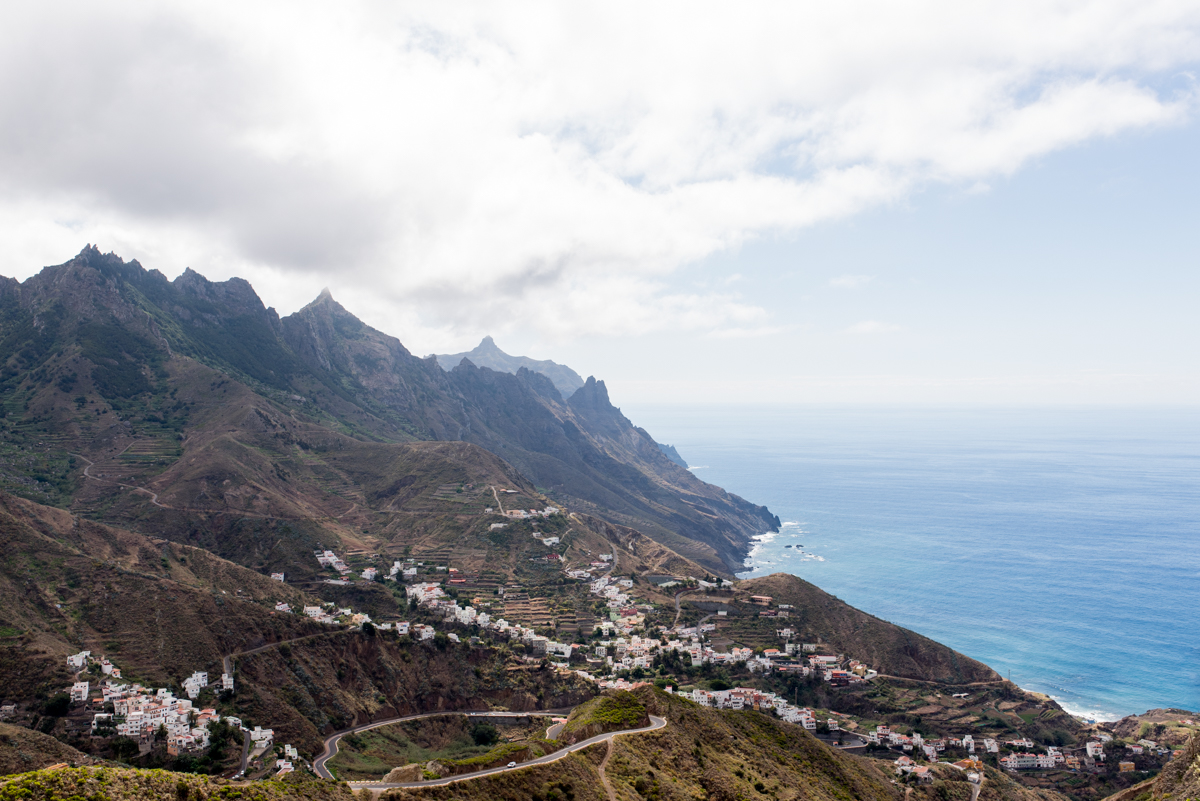
Some of Europe’s highest vineyards are found on a small island. The perimeter of Tenerife is home to small, sea-level beach towns. In the middle of the island stands a 12,200-foot volcano. It takes an hour to drive from one end to the other, but from village to village, it seems as though you’ve gone to the moon and back. Jungles, deserts, tropical beaches, and mountains; it’s like every ecosystem became an expat and moved here. Politically Spanish. By influence, Portuguese. By geography, a stone’s throw from Africa.
This dramatic landscape has also created one of the world’s most distinctive wine regions. For example: ancient own-rooted vines, volcanic soils, dozens of native grape varieties, and vineyards that climb from sea level into the mountains produce wines found nowhere else on Earth. It’s an extraordinary combination of place and history.
This is a place where passengers break into applause when your plane hits the runway or a place where shopkeepers walk you to a competitor’s store if you can’t find what you’re looking for.
In the vineyards, 300-year-old braided vines are tied with dried banana peels, while others stand on steep volcanic slopes, propped up like walking sticks on cliffsides that can only be reached on horseback.

Tenerife is the largest wine region on the Canary Islands, home to roughly 7,200 hectares (17,800 acres) of vineyards spread across five Denominaciones de Origen (DOs). Despite its relatively small size, the island contains an astonishing range of growing conditions. Vineyards stretch from sea level to more than 1,600 meters (5,250 feet) in elevation, where cooling Atlantic breezes and volcanic soils produce wines with remarkable freshness.
Perhaps even more remarkable is what grows beneath those vines. Tenerife is one of the few places in the world where ancient grapevines still grow on their own roots, untouched by phylloxera (the tiny root louse that devastated vineyards across Europe during the late 19th century). While most of the world’s vineyards had to be replanted onto American rootstocks, the Canary Islands’ isolation spared them from the pest, preserving a living piece of wine history.

The Canary Islands are also a treasure trove of native and historic grape varieties. Some exist almost nowhere else, while others survived here long after disappearing from mainland Europe.
Together they create one of the most genetically diverse wine regions in Spain. Among them are the three “Listáns”: Listán Negro, Listán Blanco (better known elsewhere as Palomino Fino, the primary grape of Sherry), and Listán Prieto (the same historic variety known as Mission in California, País in Chile, and Criolla Chica in Argentina).
For red wines, however, Listán Negro has become Tenerife’s signature grape. Depending on where it’s grown, it can produce wines that are peppery, floral, smoky, and surprisingly elegant; qualities that would soon become the focus of my trip.
Learning about Tenerife’s vineyards is one thing. Understanding why they’re so exciting requires meeting the people who’ve dedicated themselves to sharing these wines with the world. My journey began, unexpectedly, on a park bench in Northern California.
How it all started…
APRIL 3, 2017: MILL VALLEY AND JOSÉ PASTOR
By 2017, a handful of producers from Tenerife had begun turning heads in the wine trade. One of the names I kept hearing was Envínate — a small collaborative project founded by four friends who believed the best way to understand a place was to let its vineyards speak for themselves.
Those wines were finding their way into the United States thanks in large part to importer José Pastor. When I reached out to José about Envínate, I had no idea he lived in the Bay Area. It made a meeting of the minds all too easy.
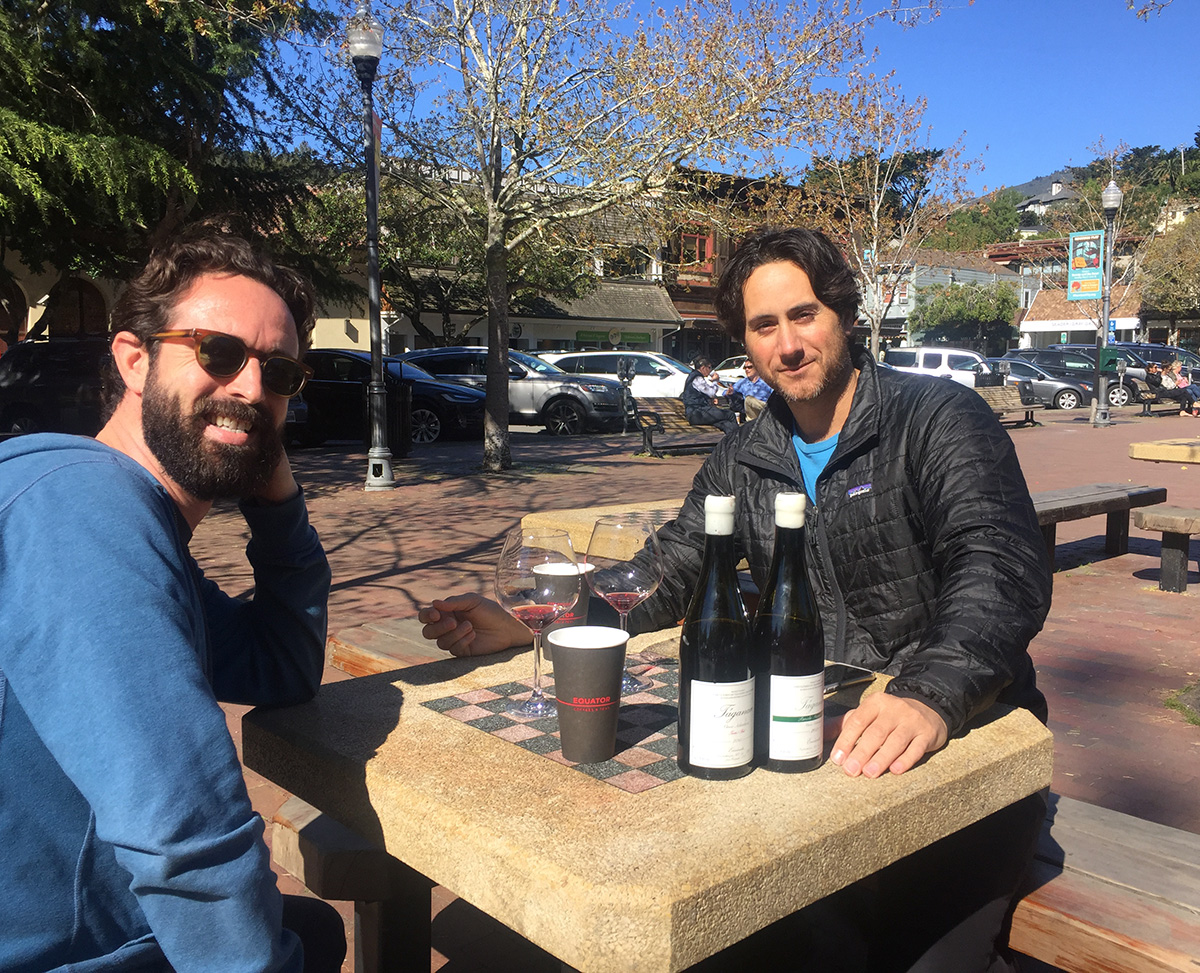
On a park bench in downtown Mill Valley, José walked me through Envínate’s lineup while Marin moms in Patagonia gear zipped past pushing strollers. It wasn’t exactly the romantic wine tasting I’d imagined, but somehow it felt perfectly fitting.
The first bottle we opened was a field blend from a tiny village in northeastern Tenerife called Táganan.
I had to ask…
Me: “A field blend huh? What grapes?”
José: “Listán Negro, Listán Prieto, Baboso, Negramoll…”
As he continued, the list of grapes got progressively more obscure.
José: “Oh, and there’s some other things in there as well.”
Me: “Ok, this is insanely delicious, but why field blends? Why not vinify the varieties separately to see what they are capable of on their own?”
José: “In Táganan, not possible…”
At the time, I assumed José was exaggerating. Later, standing above the cliffs of Táganan, I’d realize he wasn’t.

Hello Táganan
MAY 26, 2017: TÁGANAN VINEYARD AKA JURASSIC PARK
The view ain’t bad. Perched on Tenerife’s northeastern coast, Táganan is one of the island’s oldest winegrowing communities. Its steep volcanic slopes plunge toward the Atlantic. It’s easy to see why tourists flock to take photographs, prompting Envínate’s Roberto Santana to put up fake poison signs to keep curious visitors from helping themselves to the grapes.
I met Roberto, a Tenerife native who had once been warned to stay away from Táganan. “Don’t complicate things,” people told him. Challenge accepted.
Roberto: “Welcome to Jurassic Park.”
I looked over the edge. The vineyard pitched downward at what felt like an impossible angle — well over 60 degrees — with barely enough footing to stand comfortably.
Me: “How on earth do you work these vineyards?”
Roberto: “This one’s easy. It’s close to the road!”
Standing there, José’s comments from California suddenly made perfect sense.
When vineyards are this steep, mechanization simply isn’t an option. Everything, from pruning and tying shoots to harvesting, is done by hand. The challenge isn’t just the terrain; it’s the vines themselves.

Ancient vines sprawl every which way like wild shrubs; each one is a different variety. Walking through these vineyards felt like foraging, or better yet, digging up fossils. I remembered my conversation with José in Mill Valley. He was right; there would be no single-varietal wines on this side of the island.
Envínate’s Tenerife project has several bottlings. Its flagship Táganan vineyard is called Parcela Margalagua or “mother of the water.” It’s a cooler area (for the Canaries) with vines at least 100 years old. I tasted one of just 600 bottles produced of Margalagua with José, following its arc over three days. Never in my wildest dreams did I imagine such a serene, seductive red wine, born in such a violently rugged place.
Later, heading west to the Orotava Valley, we would strike gold.

Tenerife is divided into five Denominaciones de Origen (DOs), each shaped by different elevations, exposures, and volcanic soils. If Táganan feels wild and untamed, then Valle de La Orotava offers a completely different expression of the island.
To illustrate, stretching from the Atlantic coast toward the slopes of Mount Teide, the valley is greener, cooler, and more densely planted with vineyards. It accounts for roughly 9% of Tenerife’s vineyard area. Some of the island’s most celebrated producers have turned to the valley to explore what Listán Negro can express on its own.
Between 500 and 650 meters (1,640–2,130 feet), we were still less than 2.5 kilometers (1.5 miles) from the Atlantic. Here, it’s a combination of elevation, volcanic soils, and constant ocean influence that gives the valley’s wines their remarkable freshness.
I first saw La Habanera before I ever tasted it.
Envínate’s cellar sits in Santiago del Teide, on the island’s drier western side. Cacti and aloe plants replace lush forests, and the volcanic terrain stretches toward the horizon in shades of black and rust.
Inside the cellar, however, everything became quiet as we tasted through barrel after barrel from the 2016 vintage. Across nearly every red wine, I kept noticing the same thread: cracked pepper.
Whether it came from Listán Negro, another native variety, or the island’s volcanic environment, I couldn’t say with certainty. Roberto simply smiled and credited the volcanic soils. Then, we reached a barrel labeled La Habanera and time stopped.
I’ve been jolted by wine plenty of times. There’s a good jolt, and there’s a bad jolt. Bad jolt happens more often than I’d like (synonymous with bitter beer face). A good jolt is rare. Even at just 12.6% alcohol, “La Habanera” jolted me. It is hard to put into words because I can’t compare Listán Negro to anything other than a very distinctive island wine with electric energy. Enough electricity to, well, jolt you!
“I call this kind of wine a ‘light socket wine’ — the kind that shocks your palate awake.”

Goodbye Tenerife
MAY 26, 2017: GOODBYE SUPPER
At our last dinner together, at Roberto’s father’s restaurant, we took a pause to focus on people. Each person around the table said a few words. Isn’t it amazing how in the right company, a group of individuals can bond almost overnight? Alfonso said it best, “What is good wine without the company?”
Ultimately, I’m summarizing a place that somehow defies articulation. Tenerife is a lovable hot mess; full of magic, enchantment, head-scratching wonderment, and yes, really good potatoes (especially when dipped in Mojo sauce).
There is a palpable sense of community here, far from dollar-driven societies. From viticulturist José Ángel Alonso, who farms Táganan alongside Envínate, to the families who’ve owned these vineyards for generations. They all pitch in and help without a thought.
This was my first trip to Spain, yet it certainly won’t be the last. I will visit Tenerife each year to continue to be touched by these people and this place, if I can survive the long Spanish nights.